Replace fuses and relays with a power distribution module
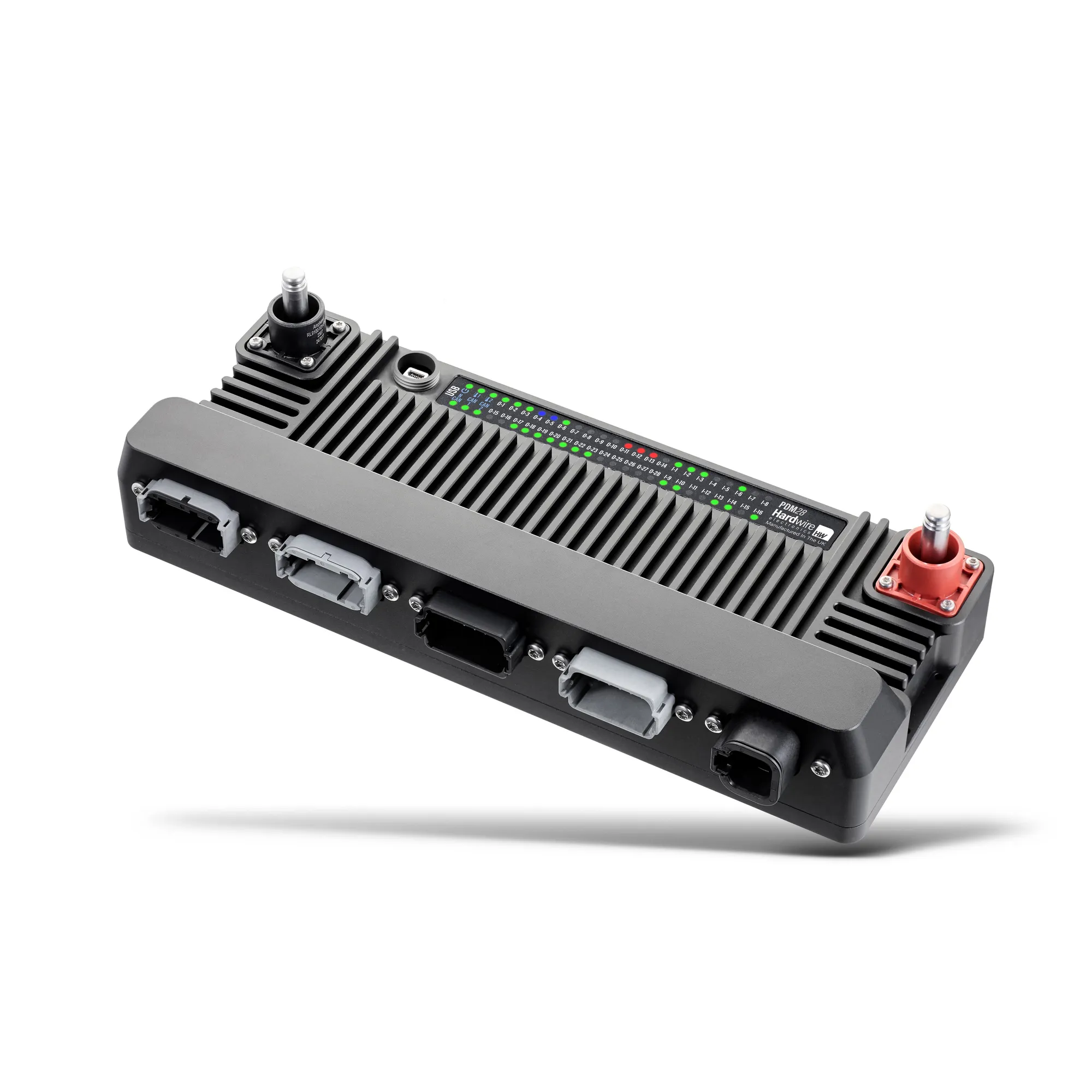
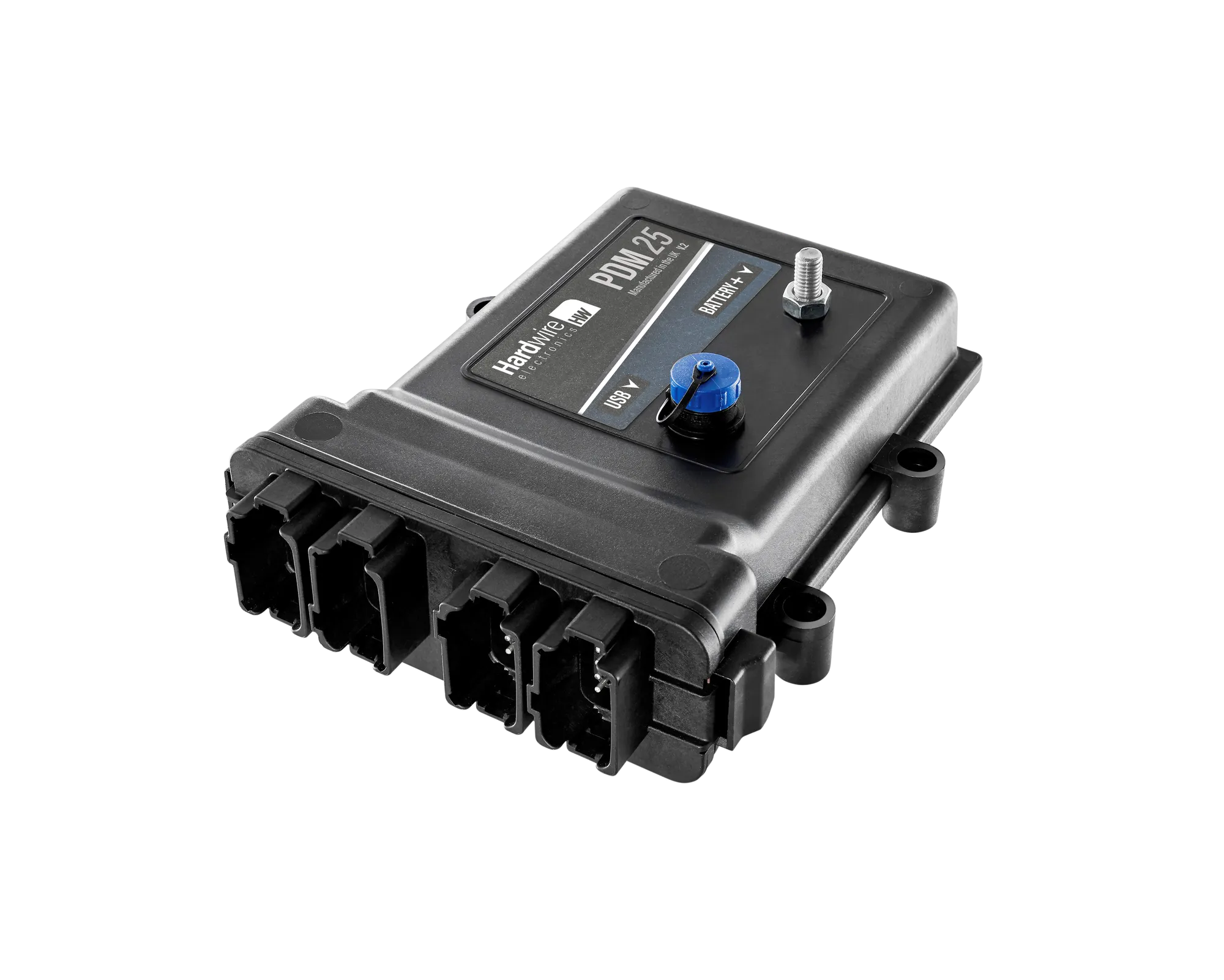
A power distribution module (PDM) replaces the fuses and relays in a vehicle or machine with one solid state unit. It switches and protects every circuit, and you set it up in software instead of with physical wiring. Hardwire PDMs run on 12 V and 24 V systems (4 to 32 V) and are designed and made in the UK.
The problems with fuses and relays
A fuse and relay box works, but it has limitations that show up as a build gets more complex.
- Relays are mechanical. Contacts wear, and vibration, water and dirt can cause intermittent faults that are hard to trace.
- A blown fuse breaks that circuit until someone troubleshoots, finds and replaces it.
- Every change to how a circuit works means a change to the wiring. Each variant of a product needs its own loom.
- A fuse box tells you nothing. There's no record of what failed, when, or why.
What a PDM does
A PDM takes inputs from switches, analogue voltages or the CAN bus, and powers the loads: fans, lights, pumps, cameras, motors, and the rest. Which output does what, the logic that controls it and the fuse rating for each circuit are all set in software, so a change doesn't mean rewiring.
Loading 3D model…
How a PDM protects each circuit
The PDM measures the current on every output, all the time. If a fault makes the current exceed a threshold, the PDM switches that output off to protect the wiring and the device. It can be set to retry the circuit, to see whether the fault has cleared, or to permanently disconnect the load until a user resets the circuit.
- Peak and High thresholds allow for inrush current, so high current loads can start without tripping.
- Each output can be set to trip instantly, or behave like a physical fuse and allow short spikes above the threshold, using time weighted average current monitoring.
- Tripped outputs can be retried 1 to 9 times, retried indefinitely, or permanently trip.
- Low current detection finds open circuits and failed loads.
- Every output is protected against overcurrent, overtemperature, load dump and reverse polarity.
We recommend still fusing the main supply to the PDM, so an entire fuse and relay network can be replaced with a single fuse and PDM.
Fuses and relays compared with a PDM
| Fuses and relays | PDM | |
|---|---|---|
| Switching | Mechanical contacts | Solid state, no moving parts |
| Protection | A fuse blows and must be replaced | Each output switches off and can be set to retry |
| Changing a circuit | Rewire the circuit | Change the software configuration, no rewiring |
| Finding a fault | Check fuses and relays by hand | Indicator LEDs, live data, trip counts and data logs |
| Water, dirt and vibration | A common cause of faults | IP67 sealed |
| Wiring | A relay and fuse for each circuit | One unit, outputs wired straight to the loads |
Using a PDM in a production build
If you're building more than one or two units, a PDM makes each one the same.
- Load the same configuration onto every unit, then password protect it so it can't be changed in the field.
- Store installation notes on the PDM itself.
- Connect it to the vehicle's controller over CAN. DBC import sets up the messages, and a J1939 data stream is built in.
- When a unit comes back, lifetime statistics and trip counts show what happened.
- We supply PDMs on an ongoing basis, with long term supply agreements, and our design and manufacture is certified to ISO 9001:2015.
Where PDMs are used
Hardwire PDMs have been in use since 2019.
Hardwire PDM modules form the backbone of our electrical system, replacing traditional fuse-and-relay architectures with a compact and fully configurable solution.
- Off-highway and industrial: mining vehicles, track-driven drills and recycling machinery. See Ecoforniture.
- Stationary equipment and energy storage: see Allye Energy, which replaced fuse and relay systems in its battery storage units.
- Electric vehicles: see Munro Vehicles and Halcyon.
- Motorsport and road cars: see HCR Innovations and Alisi Motors.
- Aircraft: see Bearhawk Aircraft.
- Autonomous vehicle development: powering the cameras, lidar, radar and computers on test vehicles, with each sensor switched and monitored over CAN, and a setup that changes in software as the platform develops.
- Defence: military land and marine vehicles, where sealed solid state switching keeps systems running through water, dirt and vibration.
Questions
Do I still need a main fuse?
While Hardwire PDMs monitor total current and do protect themselves against overcurrent, we still recommend a single fuse on the main feed to the PDM.
Does it work on 24 V?
Yes. Hardwire PDMs run on 4 to 32 V, so they suit 12 V and 24 V systems.
Can outputs be combined for more current?
Yes, outputs can be combined to increase the total current capacity to feed high current loads.
Will it work with my vehicle controller or ECU?
CAN Bus inputs and outputs are fully configurable to work with any CAN-based controller or ECU. CAN configurations can also be imported and exported easily using DBC files.
Is it E-marked?
The PDM15/25/35 V2 is E-marked to UNECE R10.06 and tested to FCC Part 15.
Can I stop the configuration being changed?
Yes. Finished configurations can be password protected so that the configuration cannot be modified by the end user.
Talk to us about your project
Tell us what you're building and how many units, and we'll help you work out whether a PDM is right for it and which one.